
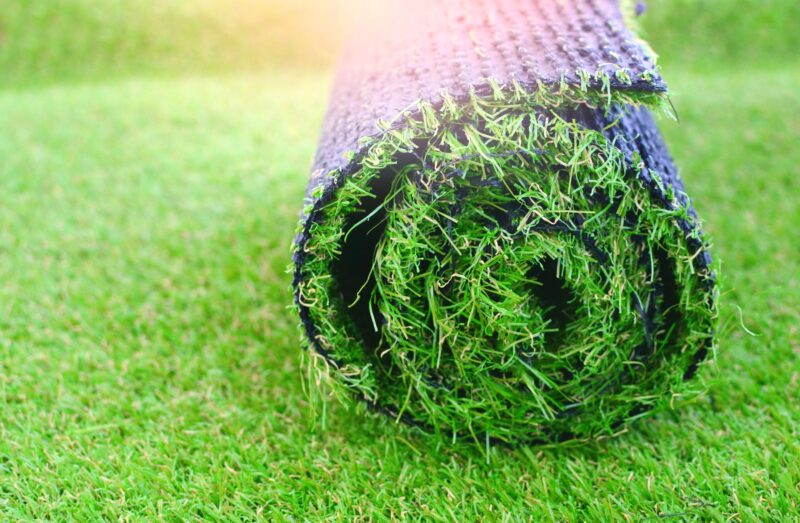
What goes under artificial grass in St. Catharines is a compacted crushed stone base, a weed barrier, and infill, all sitting on excavated and graded ground. The turf you see is only the top layer. The base underneath is what makes a synthetic lawn drain, stay flat, and survive our Niagara freeze-thaw winters. Here is the full stack, from the soil up, and why each layer matters on a St. Catharines property.
Why does the base matter so much here?
Because most of St. Catharines sits on the Niagara clay plain, and clay holds water. A lawn built straight on clay with no drainage layer will trap moisture, heave in a freeze-thaw cycle, and grow lumpy over a couple of winters. A proper granular base solves all three problems at once, which is why cutting corners on the base is the single biggest mistake in a turf install below the escarpment.
What are the layers under artificial grass?
1. Excavation
The crew removes the existing sod and soil, usually to a depth of about 3 to 4 inches for a lawn, deeper for a dog run or a driveway-adjacent area. On heavy clay lots in Port Weller or Grantham, they may dig a little deeper to make room for more drainage stone.
2. Grading and sub-base shaping
The exposed ground is shaped to fall away from the house and toward a drainage point. Even a slight, deliberate slope keeps water from sitting under the turf. On flat lots this step is critical and is where local knowledge of how a yard drains earns its keep.
3. Geotextile weed barrier
A woven landscape fabric goes down to separate the soil from the stone and to stop weeds pushing up through the seams. On clay it also helps keep the base stone from sinking into the soft ground below.
4. Crushed stone base
This is the heart of the system. A layer of granular material, typically crushed stone or a limestone screening blend, is spread in lifts to roughly 3 to 4 inches. It is the drainage highway that carries rain and pet waste straight down and away.
5. Compaction
Each lift of stone is compacted with a plate tamper so the base does not settle later. A well-compacted base is firm underfoot and will not develop dips or waves. This is the step that determines whether the lawn still looks flat in five years.
6. The turf, infill, and edging
The turf is rolled out, left to settle, trimmed to fit, and seamed. It is then secured with nails or a perimeter edge, and infill (silica sand or a coated pet-grade product) is brushed into the fibres. Infill weighs the turf down, keeps the blades standing up, and protects the backing.
How long does base prep take?
For a typical St. Catharines backyard, base preparation is the bulk of the job and usually takes one to two days on its own, with the turf laid after. Larger or clay-heavy yards that need extra excavation and drainage work take longer. The base is slow because it is done right, not because it is complicated.
Can you install turf over an existing surface?
Sometimes. Turf can go over a sound concrete patio or a solid deck with a proper underlay for drainage and cushioning. It should not go directly over soil or an old lawn without excavation, because that skips the drainage base and the lawn will fail. If you want to cover an existing hard surface, we assess it first on a free site visit. You can see the range of spaces we build on our turf solutions.
What infill goes on top, and why?
After the turf is down, infill is brushed into the fibres, and it does more than most people realize. It weighs the turf so it lies flat and does not ripple, it holds the blades upright so the lawn looks full, and it shields the backing from the sun. For a standard lawn we use rounded silica sand. For pet areas we switch to a coated or antimicrobial infill that helps control odour. The amount is measured to the turf's face weight, not just tossed on.
How much of the base can you do yourself?
A handy homeowner can manage a small, flat area, but the base is where most DIY turf jobs go wrong. Renting a plate compactor is easy; knowing how deep to dig on clay, how to grade for the spring melt, and how to compact in lifts is the part that takes experience. On a St. Catharines lot with clay and freeze-thaw to manage, an under-built base shows up as dips and puddles within a season or two, which costs more to fix than it saved.
FAQs
How deep should the base be under artificial grass?
For a residential lawn, plan on roughly 3 to 4 inches of compacted crushed stone. Clay-heavy St. Catharines lots and heavy-use areas like dog runs often get a deeper base for drainage.
Do you need a weed barrier under artificial grass?
Yes. A geotextile fabric blocks weeds at the seams and keeps the base stone from mixing into the soil below, which matters on our soft clay ground.
What kind of stone goes under the turf?
A crushed stone or limestone screening blend that compacts firmly while still draining. Rounded pea gravel is a poor choice because it shifts underfoot.
Want the base done properly the first time? Artificial Turf St Catharines handles the full stack, from excavation to the final roll of turf. Call (289) 402-5117 or request a free quote for your St. Catharines property.