
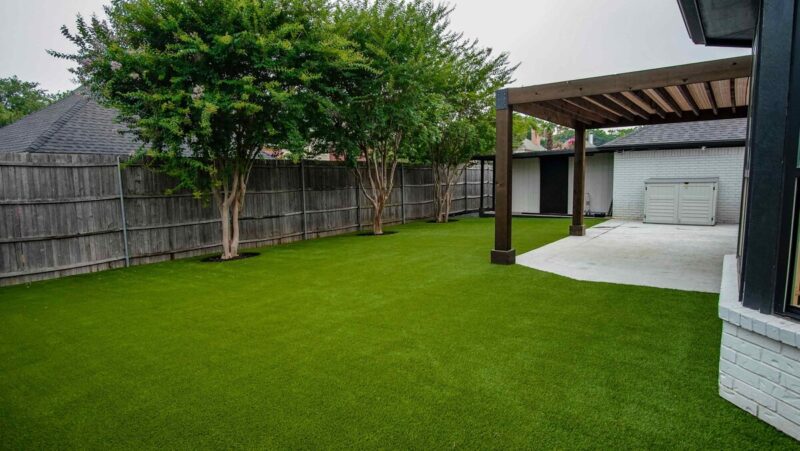
Choosing between artificial grass and natural grass in St. Catharines comes down to how you use the yard, how much upkeep you want, and how our Niagara climate treats each one. Neither is the right answer for every property. Here is an honest side-by-side so you can decide what fits your home in St. Catharines and the surrounding Niagara Region.
How does the St. Catharines climate treat each option?
Both surfaces handle our climate, but in different ways. St. Catharines sits in Canada's mildest pocket, plant hardiness zone 7a, because Lake Ontario and Lake Erie moderate the temperature. That is good news for natural lawns in spring and fall, but our humid summers still bring dry stretches and watering, and lake-effect snow off Lake Ontario piles up in winter. Natural grass goes dormant and brown in a summer drought and turns to mud during the spring melt. Artificial grass stays the same green through the heat, the snow, and the freeze-thaw swings that are common along the escarpment.
Which uses less water?
Artificial grass uses essentially none. A natural lawn in St. Catharines drinks a lot through July and August, and that water is drawn and treated from Lake Ontario before it reaches your tap. A synthetic lawn needs only the occasional rinse to stay clean. If you want to cut summer water use without giving up a green yard, artificial turf is the clear winner here.
What about maintenance?
This is where the two options are furthest apart. A natural lawn in Grantham or Port Dalhousie means weekly mowing through the growing season, plus fertilizer, overseeding, aeration, weed control, and raking up leaves and canal-side debris in the fall. Artificial grass asks for a quick brush to keep the blades upright, a rinse now and then, and clearing leaves off the surface. There is no mowing, no watering, and no muddy patches where the dog runs the same line every day.
Which costs more?
Natural grass is cheaper to put in and more expensive to keep. Sod costs little up front but adds up to roughly $800 to $1,200 a year in water, fertilizer, and mowing for a typical St. Catharines property. Artificial grass runs about $10 to $25 per square foot installed and then costs almost nothing. Over eight to ten years the two often even out, and after that the synthetic lawn keeps saving. We break the numbers down further in our artificial grass cost guide.
When does natural grass still win?
Real grass is not obsolete. If you love gardening and the ritual of lawn care, or you have a large rural property near Short Hills where the cost per square foot to convert would be steep, natural grass can make more sense. Grass also cools the air around it and supports soil life in a way plastic fibres do not. The honest answer is that a big, shaded, lightly used lawn may be fine as sod, while a small, sunny, high-traffic yard that turns to mud is a strong candidate for turf.
Which is better for heavy use and pets?
Artificial grass handles traffic that would wear real grass into dirt. Kids, dogs, a backyard rink pad, or a shaded corner where sod never fills in are all cases where synthetic turf holds up better. Our clay-heavy soils compact under repeated foot traffic, which makes bare, muddy patches a common complaint on natural lawns below the escarpment. A properly drained turf base avoids that entirely.
How long does each option last?
A natural lawn lasts indefinitely if you keep feeding, watering, and reseeding it, but it looks its best for only part of the year and needs constant work to stay that way. Quality artificial grass lasts many years with almost no effort and looks the same in February as it does in July. For a busy St. Catharines household that does not want a second job in the yard, that consistency is the real draw.
Which is better for the environment?
It depends on what you weigh most. Natural grass cools the air, absorbs rain, and supports soil life, but it also runs on treated Lake Ontario water, gas mowers, and fertilizers that wash toward the canal and local creeks. Artificial grass is plastic and is not biodegradable at the end of its life, but it removes watering, mowing emissions, and lawn chemicals for a decade or more. There is a genuine trade-off here, and the honest answer is that neither option is purely green.
FAQs
Does artificial grass look fake next to real grass?
Modern mid-grade and premium turf uses varied blade colours and a thatch layer, so from a few steps back it reads as a healthy lawn. Entry-level products look flatter, which is why grade choice matters.
Will a natural lawn survive St. Catharines summers without watering?
It will usually go dormant and brown during a dry July, then green up again with rain. It survives, but it will not stay lush without watering.
Can I mix both on one property?
Yes, and many homeowners do. A common setup is turf for the high-traffic backyard and garden beds or a small sod strip out front. Our Artificial Turf St Catharines installers can plan a layout that blends the two.
Not sure which way to go for your yard? Talk it through with a local crew. Call (289) 402-5117 or get in touch for a free, no-obligation assessment across St. Catharines and the Niagara Region.